Aetherian Animals
backIn this entry of Tape Hiss, I'll be talking about a few Aetherian animals: not just wildlife, but livestock, animal products, pet ownership, etc. This one will have undergone quite a bit of editing from the original Tumblr post.
Quick sidebar: The dragons seen in statue form around the Palace are not Aetherian, nor are they animals in the sense we're talking about here.
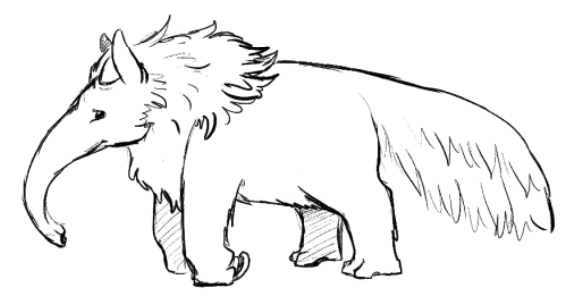
The kuuv that we see in the comic is a domesticated animal that fills the same niche as cattle. There are wild versions, but they don't occur close to spirit habitations. They are root- and fungi- eaters, and use their large front claws to dig up food; this inadvertantly tills the soil, which is instrumental in the spread of the same kinds of roots and mycelium from which they feed. Wild kuuv are much larger than their domestic counterparts; the domesticated version has also adapted to eating cut hay, in addition to their usual diet.
Domesticated kuuv are one of Aetherian's most important creatures. Their feeding habits are employed in farming; a farmer will turn them out on a pasture, which is then torn up into plantable land after a season of grazing, and then the herd is moved into another pasture which has been fallow for a year, allowing a fresh crop of roots and fungi to grow for the kuuv to then eat. Kuuv are also raised for their fur (shed naturally each year), hides, meat, and milk (thick, yak-like, used for cheese and cream rather than drunk.) They also make great beasts of burden and can pull vehicles over long distances.
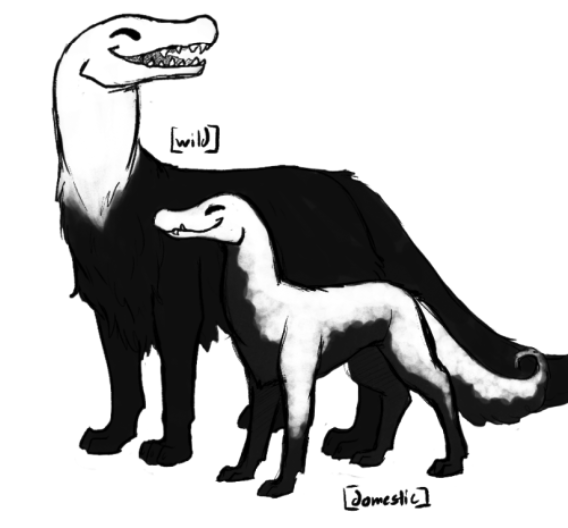
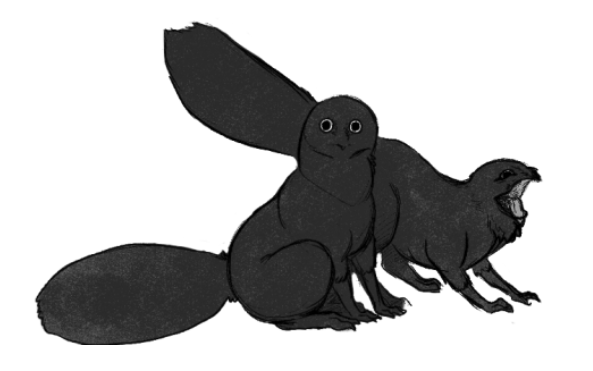
Suoki (soo-oo-key) are another domesticated Aetherian animal with a larger wild counterpart. Size and temperment are the only difference between the two; the domesticated suoki still only comes in black-and-white, though selective breeding has introduced coat patterns not present in the wild type, along with a much milder temperament. Suoki fill a niche like, but not equal to, dogs do with humankind: they have been a companion to spirits for millennia, though spirits have not gone so far in changing them as humans have dogs. Being quite intelligent and easy to train, they're well suited for any number of jobs, from pets to service animals to livestock guardians, herders, etc. They can also mimic speech and can even be trained to use phrases appropriately. One common use for them as a service animal is for people who are non-verbal for whatever reason, or as medical alert animals, where they can be taught to act as a go-between for their owners and emergency personnel or bystanders. People new to Aetheri often find suoki creepy, what with the speech and the fact that their bark sounds like laughter, but you generally have nothing to fear from a suoki if you have nothing to fear from their owner.
Wild suoki also have much more shaggy, thick coats compared to the domesticated type, whose coats are often described as seal-like. The wild type are solitary for most of the year, though in lean times they will come together to hunt. They use their coloring to blend into the misty grasslands at night, and a hungry enough pack can be dangerous even to an Aetherian trading caravan, since their size and bite strength makes it entirely possible for a group of them to pull a kuvv straight out of their yokes. Solitary individuals mostly hunt laar, being one of the few animals fast enough to catch one in an outright chase, but they have been known to try their luck with a lone spirit traveller if desperate.
The suoki is also the symbol animal of the du Russi house, along with an edible flower called enlar and the colors turquoise and deep red (pigment of which is derived from enlar.)
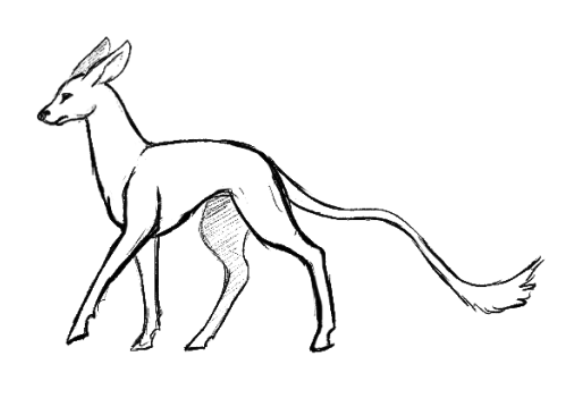
The laar is a split-hoofed herbivore that can sustain speeds up to 90mph for an hour at a time and can turn on a dime. In Aetheri they are used for racing, herding, carrying messages/mail, and pursuit; the national army has a special branch of laar riders that handle carrying intelligence as well as running down slavers and bandits. Riding a laar is a specialized art in itself. Riders must be very small and very strong, as a laar's gait is more like a greyhound's than a horses, in that their backs flex and their heads are not held even relatively still as they run. A rider essentially has to hold themselves up in a crouched position while the animal flexes beneath them when going any faster than a brisk walk. Convential Aetherian wisdom says that someone who rides laar for a living is not to be messed with, as they could likely crush your skull with their thighs.
Domestic laar were bred to get rid of the swept-back, showy antlers that the wild type possess, as they'd naturally interfere with riding. While riding them itself is difficult, training is not; even wild laar are fairly easy to tame. They love running, and domestic laar must be turned out in large pastures in warmer months to get the zoomies out. They communicate by stomping their hooves and making whistling sounds that resemble a guinea pig's.
The wild laar specifically, with its curved antlers, is the symbol of the d'Escala house, along with nine tubular bells and the colors purple-grey and gold.
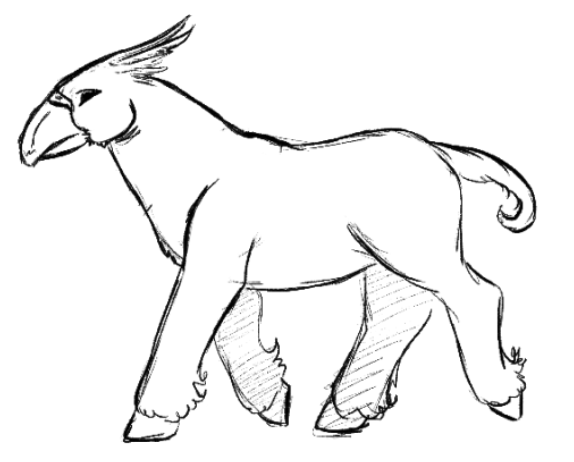
The huurtai exists in the gap between the slow but powerful kuuv and the fast but slight laar. They are straight-backed, single-toed animals with alpaca-like fur, and are used for distance and recreational riding, herding, fur, and meat. They are generally quiet animals, but when angry or alarmed can make a sound like a very large goose.
The domesticated version has a stubborn temperament and can be almost mischevious to the point of destructiveness, especially when young. They require early training and patient handlers, to whom they usually get quite attached. In Escalus in particular they are favored for intra-city transport of goods and people, being much more able to navigate narrow side streets than the larger kuuv.
In the wild, huurtai live in herds and are omnivorous; they use their large beaks to strip certain plants of berries, bark or millet-like seeds, but also to catch and eat small creatures in the grassland. They will also comingle with herds of kuuv so they can feed on what the kuuv dig up. Wild huurtai are considered nuisances in some cases; they've been known to pull up tent stakes or free picketed animals, knock over campsites, and raid food supplies, seemingly just for the fun of it.
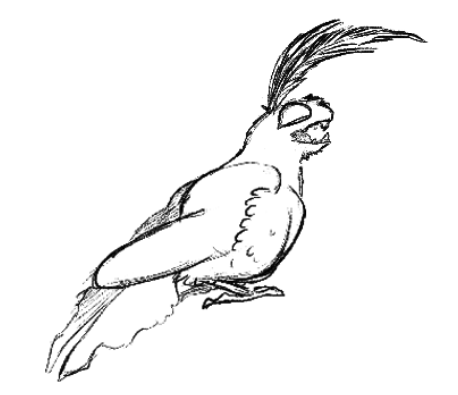
We haven't seen many actual living rit in the comic yet, just constructs styled after them. 'Rit' doesn't describe one species, but is a catch-all for a number of species, like 'birds' or 'fish'. They are mostly omnivorous creatures that live just about everywhere, though some species are more specially adapted to one food/habitat than others. What appears to be feathers are keratin structures that more closely resemble the scales on a moth's body. Likewise, they have large, multifaceted compound eyes, and little toothy mouths that are often obscured by scales. They can see a wider gamut of colors than humans or spirits though in most species their dim-light vision is extremely poor. They do not have ears, but instead use their antennae to pick up vibrations. Their vocalizations vary widely over geography and species, but common species in Aetheri stick to soft cooing, whooping, sighing, or coughing sounds. Their vocalizations have an infrasound component that are not usually audible, but are picked up by the antennae of other rit.
There is only one kind of truly domesticated rit, a ground-dwelling variety used for eggs and (somewhat less frequently) meat. All rit lay soft-shelled, oblong eggs that are often cooked in-shell and eaten whole, or else split open and used for baking. The meat has a texture somewhat like firm tofu or seitan, and like those it takes on other flavors very well. For some reason, people with shellfish allergies are also likely to react badly to rit meat, though not the eggs.
The rit, specifically a species called suanna-rit, is the symbol animal most associated with Cuppra, despite there being no descendant family line. The other symbols of the du Cuppra are the nilaqudh (a knotted cloth used in Aetherian 'marriages') and the colors yellow and dark plum.
As an aside: that there are no other kinds of domesticated rit points towards Aetherian attitudes with regards to keeping animals. Meat is part of Aetherian diets and animal products are used for any number of goods, but animals are not overall treated as a dumb resource the way they have been/still are over quite a lot of human history. Spirits consider themselves as much an animal as anything they eat, and having been a prey species in the past, they don't consider themselves or their diets exempt from the greater food web. But because they have the ability to make the death of an animal painless and quick, they generally feel that it's their obligation to. There is very little waste in the Aetherian food system; they eat and use anything that can be eaten or used.
Not to get too into the weeds on the topic of diet, but it is fairly easy to avoid eating meat in Aetheri if you're inclined. It's not considered an essential part of one's diet or necessary for every meal. Aetherian diets also include quite a bit of insect protein (debatable if this is considered meat), as well as mushrooms of incredible variety, flavor, and texture. Avoiding grains is much more difficult.
The dhuullena is mainly used for labor and trade; they're generally too big for daily use in an urban setting like Escalus. The domesticated versions are very docile, while the wild type are very territorial. Both use their modified front 'legs' to pull up grass and reeds for food. They are more closely related to rit than to the other four-legged herbivores listed here; they have similar compound eyes, though rather than having high color vision theirs are specialized for seeing farther and wider, in the dark, and detecting movement. Their coats are very coarse and consist of flat, bristly scales; their tough hides are good for work clothing and are also used as a sort of sandpaper.
The fetthu is sort of an odd one out in usual Aetherian fauna. They were initially native to Cavillace, a tropical country far to the east that Aetheri occasionally trades with, and were imported as pets before the war. In the time since they have gone feral and essentially become naturalized in the new climate created after the fires; their ecological role is now as a predator to the types of pests that are attracted to spirit habitation. They're one of the only examples of an introduced species that has escaped domesticity, as Aetherians post-war and post-fires are extremely deliberate about their ecological stewardship and have some strict regulations in place to prevent this kind of thing.
They are still sort of kept as pets, but not as companions, not usually; having gone feral, they don't often bond with people, though with some work they seem to accept a sort of arms-length relationship. It's a lot like having an outdoor cat that barely tolerates your presence. The typical fetthu 'owner' merely provides an open window through which they can come and go as they please, as well as some food, water, and a spot to sleep. They can sometimes be tame enough to pet, but that's about as much affection as they will usually tolerate; usually the best you can expect is the sort of amiable companionship of being in the same room at the same time.
Over time it seems like fetthut may be gradually turning back towards domestication again, but there's not much hurry to do it on purpose. They do have nice chinchilla-like fur that comes in an array of interesting patterns, but they also smell slightly like mildew, are nocturnal (and vocal at night), can be destructive if kept inside, and swallow prey whole before horking up the bones and fur in the form of pellets.
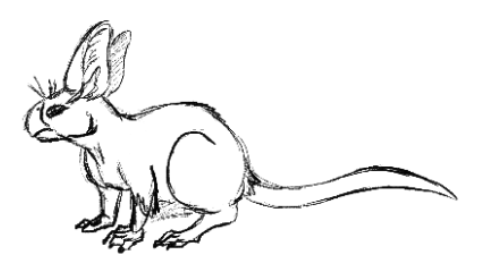
The matuury is not Aetheri's only small pest, of course, but it is the one we're most likely to see in the comic. The most remarkable thing about these guys is that they are adapted to live entirely within larger spirit settlements; a component of their diet is the limestone present in the caves and aquifers beneath Aetheri, Ryvar, and other smaller towns along the river, so they are very rarely found outside of these places. They are blind in anything brighter than very dim light and live in the dark parts of structures, ie behind walls, in basements, etc. They will chew into unprotected limestone plaster as well, and the rest of their diet consists mostly of arthropods, which also makes them a huge pest to insect farms where they're able to infiltrate.
Like rats, though, large groups of them will consume anything and everything if they're hungry enough, including incapacitated living creatures. One of the darker rumors about the d'Escala family is that they have utilized the large matuuryt population inside the walls of the Palace to rid themselves of more than one enemy.
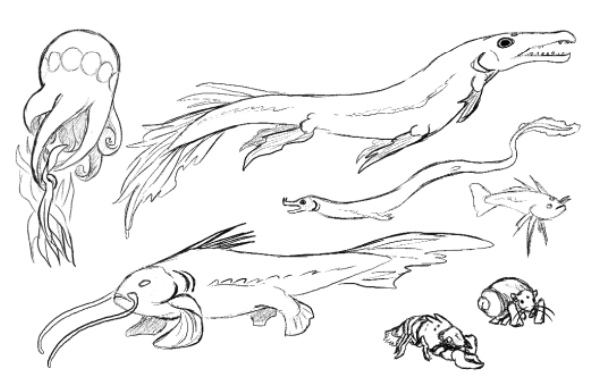
The river running through Aetheri is of course home to its own ecosystem. The collective name for the fauna in this ecosystem is lrecca, which covers pretty much any animal that doesn't leave the water for any significant part of its life cycle. There are as many weird and varied forms of lrecca as there are fish, though the ones that look most fish-like to us tend towards a longer and more snakelike form than most bony fish on Earth. (Fun fact: the Aetherian word for 'dragon' is freillrecca, which can be translated more or less as 'big fish.')
Almost all lrecca that have true eyes have a third, less developed eye--more a photoreceptor--on the top of its head which is useful for detecting light and movement above the animal. Evolutionary theory in Aetheri contends that this third eye eventually developed into the magical sensory organs that spirits and some other animals have today, which are located in the sinus area and along the nose.
Also pictured here is a lum, one of many cnidarian-like animals that eat smaller lrecca. They are bioluminescent and, rather than floating freely in the river's sometimes very fast currents, pull themselves along the bottom by gripping weeds and rocks. The river is, over most of its course, very deep and fast, but you can often see lumt moving along the bottom at night, glowing very faintly.
Many species of lreccat are part of the Aetherian diet. None of it tastes like or has the texture of fish (almost nothing in Aetheri does, and a lot of Aetherians find the flaky texture of cooked fish very upsetting as a result.) Most lreccat have a texture like freshwater eel or squid. Lumt are also used as an ingredient; they are easily processed into a tasteless gelatin-like substance that is often cubed, chilled, and covered in a sweet syrup on shaved ice as a treat during the hot months. (There is also a form of gelatin derived from river plants, but it's generally agreed that it doesn't hold flavor as well, and is usually used as a thickening or gelling agent in other applications.)
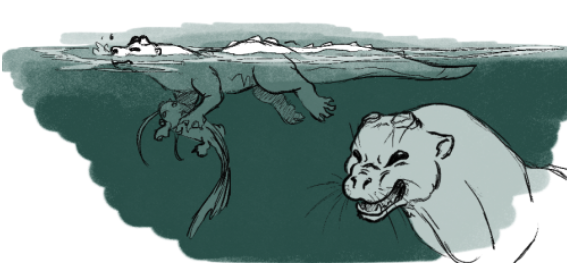
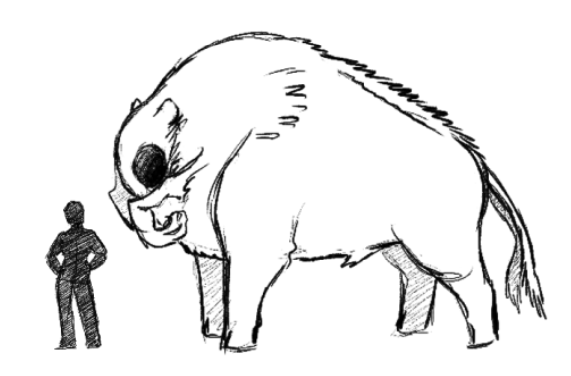
Lastly, there's the ydde (ee-dee) which, contrary to its appearance, is an egg layer. They eat mainly various lreccat but will try just about anything. They don't stray far from the shores of the river, and are solitary and territorial; they use their plated skulls to knock heads with rivals over territory. They can appear aggressive towards people who approach, but they almost never attack anything larger than themselves. You can usually just ignore them, and they'll just stand a ways off huffing and stomping and making hwouping noises. They tend to avoid Escalus due to how busy the waterway and shorelines are, but occasionally one will get lost in the city's canal system and cause some excitement by ending up in someone's courtyard.
They are occasionally hunted for their water-repellent skins, but usually only in rural areas where some good spelled rain clothes might not be available. They don't make good eating--they have dark, greasy meat--and their eggs are not usually eaten either, due to the danger in collecting them. Brooding yddet pairs take turns protecting their nests, and will get extremely aggressive with invaders. The eggs themselves are very hard-shelled and not remarkable in terms of taste, so most people don't have much interest in them anyway.
That brings us to the end of this Tape Hiss entry. Of course, there are plenty of other Aetherian animals worth talking about; maybe I'll update this page if any of them are due to come up in the comic, just for interests sake.