The Body Trafficking Industry
backThis month's Tape Hiss is tackling a topic that's driving much of chapter 7 (and the story overall): the slave trade, or the body trafficking trade, as it's more accurately called. I'm going to talk about the evolution of the trade over the centuries, the effects it's had in various places, the kinds of people/things that the trade targets and why, and what kind of efforts to stop it have been made.
The body trafficking trade as it exists in the WN universe has existed as long as there have been people who want things that are illegal and/or unethical to obtain, and it will likely always exist. Calling it ‘the trade’ makes it sound like one large centralized entity, but it is definitely not that. The term 'body trafficking’ just means that the 'products’ involved in this trade are bodies (dead or alive) and body parts; the 'trade’ overlaps with a thousand black markets (and some legitimate ones as well) across a thousand worlds. When people like Numair talk about fighting the trade, they never mean that they aim to destroy it entirely–that’s just not possible. Instead, 'fighting’ here usually means attempting to uproot the trade in key places, to break its grip on communities, to cut off its supply.
Like Teige mentions, not a lot of people who get taken into the trafficking industry make it out again. This is really just due to the scale of the thing. A person who is picked up on one world very likely won’t stay on that world for very long, and they could end up literally anywhere, sometimes in worlds that were completely unknown to their own. There’s a phenomenon with worlds in the multiverse called a 'neighborhood’ wherein a given world is usually only acquainted with or even aware of a finite number of worlds within a certain number of steps removed from itself (independent of whether or not that given world is aware that there are in fact an infinite number of worlds.) So to bring back an image from my multiverse post:
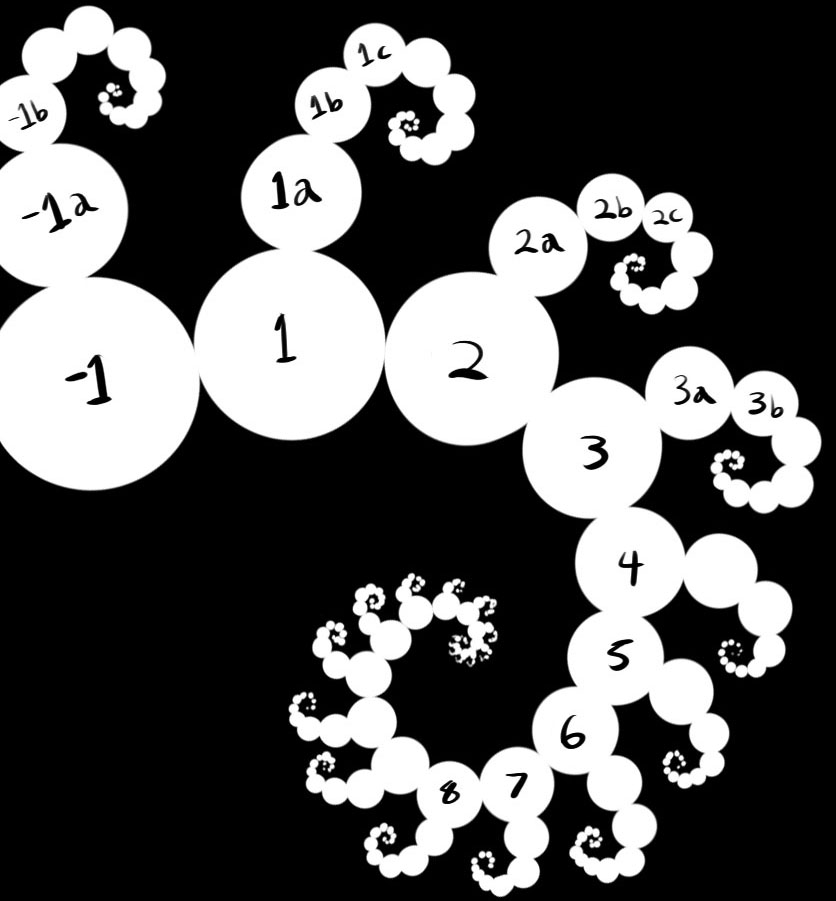
Take world 2. We’ll say in world 2’s neighborhood are worlds 1 and 3–these would all be worlds that world 2 has at the very minimum located and identified as existing in their vicinity. There may be a world -1 whose interdimensional exploration is a little more advanced, so their neighborhood may consist of worlds 1, 2, 3, and 4 (in this case, -1 knows 2 is there, but 2 doesn’t know -1 is there, as it’s out of their particular capability to observe right now for whatever technological or magical reason.)
For the sake of argument, let’s say Aetheri is world 2. A spirit gets picked up by a slaver in Aetheri (perhaps they were plucked off the streets, or perhaps an enemy of theirs enabled the slavers to pick them up, or perhaps their own family sold them off for whatever reason [this has been rumored to happen, generally in upper-class older families, with members of the family that the rest found lacking in some way.]) The spirit that is picked up won’t stay in Aetheri for very long, because there’s no market there. Spirits are commonly sold off as exotic slaves in some worlds.
Perhaps in this example, the spirit ends up on Earth, where they’re purchased by a rich asshole who has a thing for pretty, androgynous, youthful-looking people who don’t speak the language, never seem to age, and–in most cases–won’t get pregnant. On one hand, if this is where this spirit ends up, Earth is a world well known to Aetheri; the Order passes freely through most countries whether legally or covertly, and they are familiar with the supply chain, so to speak, of the trade on Earth, as well as with some of the big clients and kingpins involved. Additionally, if this spirit managed to escape at all, there’s a nonzero chance that they may eventually wind up home again. Aetheri has repatriation agreements with several countries on Earth that essentially stipulate if an escapee from the trade ends up in the hands of authorities, there’s protocols in place that eventually get the escapee to the right people who can send them home. On the other hand, I don’t know if you know this, but the Earth is big. People vanish without a trace all the time. There’s a very good chance this spirit will never be found.
Alternatively, the spirit could end up in a world that Aetheri has never had contact with. They could be shuffled from Aetheri to world 3, then 4, then 5–and then they’re gone. It’d quite literally be like being abducted by aliens from an unknown planet. Where would you even begin to look?
The live body trafficking part of the trade is bad enough. Spirits are generally sold as pets or slaves because of their appearance–even though quite a lot of them are or could be excellent fighters or at least quite physically strong, they don’t really look the part. Their resemblance to humans also means they aren’t often sold for parts, as I’ll get into.
For non-spirits, though, the range of fates is much wider. Big, strong creatures (sentient or otherwise) are often sold as gladiators across any number of worlds, some where they become the secret entertainment for the very wealthy, some where the practice of having enslaved creatures fight each other is a common sport for the hoi polloi. This is what Kei was aiming to do with Hawk.
He wasn’t exactly completely wrong about Hawk making a decent fighter, as there’s always a demand for variety–people love to root for the small underdog who strangles huge creatures with his bare hands, or else they really love to watch them get completely and totally eaten alive. Kei was just not very good at the process of making a pit fighter out of Hawk, partly because he’s an inexperienced idiot, and partly because Hawk’s temperament would have never been suited for it. Forcing an enslaved monster to commit to being a pit fighter while also not creating something that will turn and kill its handler, as Aries said, is something of an art in the trafficking industry. It is, quite literally, like training a dragon. In Hawk’s case, he’s just too stubborn. He would always, always, always be ready to break loose the second someone slipped up. That’s especially not a trait you want in a pit fighter that will inevitably spend time free to move in an arena with vectors for escape.
Many creatures, if they're big and strong but not particularly well-suited for fighting for one reason or another, might be sold for physical labor. Or, if they're not strong creatures--or if they just look particularly interesting--they're often sold as curiosities. Some will end up in public or private zoos, where the conditions vary considerably depending on the world and culture, but where they will be treated like animals nonetheless. Some become pets or slaves in the same sense that a spirit might. Very often, with particular species, they will be sold into their own species as a slave, albeit on a different world--for example, a particular monster may have lived their entire life on Earth, even though their kind is from a different world altogether originally. They may end up enslaved on that different world where their own kind is the dominant species, but they may never have visited this place, or possibly even known it existed. Still other monsters may find themselves kept as specimens somewhere for research purposes, to be studied by less than ethical scientists or sorcerors.
There are human victims of the trade as well. There's a small part of the industry that mirrors the human trafficking industry as it exists in real life, just on a multiworld scale, but it's small because there's not much cause for shuffling ordinary human beings off to other worlds, except to places where they're as much curiosities as any cryptid--and then they often find themselves in the same sort of zoos that many monsters end up in. The bulk of human slave trade victims, however, consists of healers. There are plenty of healing mages who aren't human, of course, but the advantage that the trade sees in collecting human healers specifically is the lack of claws and teeth, and that without either a weapon or more destructive magic, they're comparatively easy to control. As I've mentioned, 'nervous' healers like Liya who can destroy as much as they heal are--while not rare--much less common than the kind that can only heal.
Healers are sold for a lot of different purposes, but the two major ones are A) sideline support in arena fighting, monstrous or otherwise, and B) in war zones where military leaders are desperate and/or under-equipped and outnumbered. This last on is particularly bad, not just because it's a particularly dangerous environment to be dropped into, but also because as hard as most body trafficking transactions are to follow, sales to small guerilla military factions operating out of what might be total wilderness are night impossible to track down. (This is probably where Liya would have ended up--nervous healers are often passed over to these groups because there are pretty much no consequences to the slaver if the healer manages to kill their captors, and there's often nowhere for a healer to go even if they do escape, so there's a higher chance that they just behave themselves.)
The parts business is a whole different horrible side of the trafficking industry. Think of all the things that animal parts are used for, and then add in every use for magical ingredients you can think of, and you have the market for this side of the industry. Museum collections, private collections, research specimens, home decor, spell components, materials for clothing and weapons--just about everything can be sold somewhere. Often the inherent magical properties (real or perceived) of things like skin, hair, and bone are what make them desirable. A unicorn's horn is like a magical battery, for example, even after death. The skins of many lesser dragons make terrific lightweight and fireproof armor. Gryphon feathers are associated in many places with light and metal, and are often used in magical workings for creating anything from booby traps to solar panels. Wearing the hide of a shapeshifter like a pooka can boost the wearer's own shapeshifting abilities. Kelpie lungs can be used to create elixirs for breathing underwater. And, of course, there are people who just think it would be cool to have a taxidermy peryton or the skull of a jackalope or a dire bear-skin rug.
Aries' proposed 'use' for Hawk as a bunch of counterfeit parts is a pretty common fate for a lot of mixed species people who find themselves picked up by slavers, although what ultimately happens to a mixed species person is really dependent on how they look. If they're particularly beautiful, there's probably someone out there who doesn't know or care much about the pedigree but would be pretty pleased with a discount exotic pet; or if they're at least particularly interesting-looking, there's any number of sideshows that regularly trawl the trade looking for cheap exhibits. But Aries has been doing his job for quite a while, and he's likely seen enough people with the same kind of look in their eyes as Hawk has to know it';s wiser not to give them the chance to escape.
If a mixed species person is none of these things, they’re often, frankly, just murdered. And then, allegedly, used as 'feed.’ What people in transit in the trade are fed and how they are kept varies depending on the sorts of people handling them, but it’s usually pathetic at best and utterly horrifying at worst.
So that's what happens, but how does this happen, and why? And what's being done about it?
In a lot of ways, the body trafficking industry works about like one would expect. People are often snatched off the street in the same way Liya was by a 'wrangler' as Kei calls it, who tends to be someone bigger and ostensibly stronger than their target. Sometimes people are lured in through the promise of work or some other opportunity; sometimes, where the industry overlaps with other organized crime, disappearing someone into the industry is an easy way to get rid of them while making a buck. Sometimes people are sold in to pay someone else's debts, or just to get rid of them. In some places, many people may be taken in at once in a raid as Hawk was; this might be done by government-affiliated groups, local extremists, or in less protected rural areas, groups of slavers themselves.
On the other end, the people who work the trade at different levels do it, naturally, for different reasons. Wranglers like Kei are just about the lowest level in the whole industry (his ascension to his new job is a real rags-to-riches tale.) Some wranglers are in it because, depending where they are, working for the trade may be the best or only way to provide for themselves or their families. In some places, organized crime is so entwined with the trade that if you owe someone in charge a lot of money, getting put to work as a wrangler is much more preferable to becoming one of the victims. Most wranglers aren't really doing the job because they just love being evil; many of them cultivate a pretty frightening disconnect between their humanity (for lack of a better term) and their victims', and convince themselves they don't know what happens after they turn their victims in.
Of course, there are wranglers who are just assholes well-suited for work that involves oppression and brutalization. And pretty much no one above this level in the hierarchy--the people who transport, store, buy and sell--are doing their job unwillingly; you don't get that far if you don't want to. They're doing it for the wealth or power or whatever leads people to do these things.
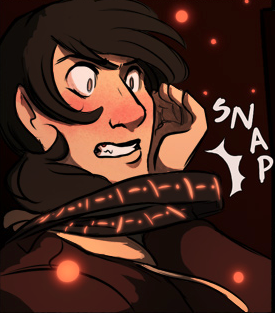
On the equipment side, the trade is a breeding ground for some pretty ingenious magical inventions, it must be said. The dampening straps we've seen used in the comic are one such thing. They are designed to be simple enough a spell for just about anyone to make of any skill level, and they work through mental trickery. The setting of the charm in the material (usually leather, sometimes metal) is done through carving, and the pressure applied into that process is translated to a 'pressure’ in the charm. The markings themselves are just lines and dots, to simulate a scratching-out, or an interruption. The sum of the charm is that, when the circuit of it is completed (i.e. when a collar is fastened or cuffs are locked,) the magic of the wearer is not 'contained’ in the traditional sense of the word–it’s not locked in, gone, or unavailable. Instead, the charm interrupts the connection between the brain and the magic. Anesthesia works similarly, in a way: it’s not that the brain is quiet at all while under anesthetic, it’s that the parts of the brain that need to communicate to do things like register pain and uphold consciousness cannot reach each other. Wearing a dampening strap is apparently like having a very slight pressure headache at all times, just enough to make it difficult to concentrate.
The reason this approach suits the trafficking industry so well is that to cast the sort of spell that would contain magic within the confines of the wearer’s body would take quite a lot of skill and power, whereas anyone with a lick of magic can use this spell to just interrupt the wearer’s mental faculties. It’s the difference between designing a high-power transformer and using a potato battery to give someone a little shock.
The downside of this is, because this method doesn’t actually contain the magic of the wearer itself (merely preventing them from having the concentration to utilize it) the magic can still react on its own and effectively short out the spell. This is what happened between Hawk and Aries. Whatever Hawk’s got going on reacted to whatever Aries has got going on--the arc that completed between them obviously channeled quite a lot of energy between them in an explosive burst, more than the spell could mute. Usually, though, the spell remains in place afterward–in Hawk’s case, the burst of energy, having nowhere else to go, caught his clothes and the ropes and collar on fire instead.
There is a side effect of dampening straps worth mentioning, because it’ll come up in the comic indirectly or not: being under a dampening charm long-term can permanently impair someone’s ability to use their magic. There are cases of people getting out of the trade after decades who then have trouble using their magic well or at all, and not because they’re rusty at it.
The other big tool used in the trade is another one that’s come up: wards. The wards that Kei was using (and that most traffickers use) employ the same mental trickery that dampening charms do. They introduce a blind spot into people who interact, incidentally or purposefully, with the object that they are set on–they discourage the brain from really noticing the object, and so unless you know exactly what you’re looking for, your attention will just skate right over the warded object. This is opposed to a traditional spell to prevent someone from finding a place, an example of which would be the alleyway that Vlad uses to get into the underground; in that case, the spirits following them would have been able to tell there was a spell there that does something, but they wouldn’t know how to use it or what exactly it did.
The advantage of wards over this is simple. If the hangar had been spelled to be un-enterable the way the alley was, the Royal Order would have known it was there immediately, and they’d just wait around for someone to come out. Additionally, spells require more energy than wards, since wards just rely on mental trickery; if there’s a spell on a place as large as a hangar, lots of people sensitive to that sort of thing could notice it from quite a ways off, and that’s no good. Instead, the Order was likely stomping around in the snow for quite a long time, knowing that there was something in the area they should be looking into, and seeing the hangar, but not really seeing it. The disadvantage of wards is that because they rely on the brain not paying attention, they’re fairly easy to accidentally break by drawing attention to the place…for example, by making a big racket. When the truck horn went off, that would have been enough noise to attract enough attention to outweight the wards, and the Order would have quite suddenly noticed the hangar there.
Also, a note, since this will come up in the comic as well: these kinds of wards are not exclusive to the trafficking industry. They’re a little tricky to make so they’re not incredibly common, but their other big application is on clothing, for people who want to discourage others from noticing them. This can be used for some pretty nefarious purposes, sure, but they’re also often used by celebrities who just want to go out without being bothered. They’re much less reliable on clothing, though…the second that the wearer interacts with anyone more than superficially, they stop working, and they also have a higher chance to fail the fewer people are around, since much of the wards’ ability to trick people into not noticing the subject is dependent on those people paying attention to something else, i.e. other people in a crowd.
There are a lot of tools of the trade that work in this vein--relying on simple, low-energy tricks--but we’d be here an awful long time if we tried to cover them all.
While the trade is massive and spans many worlds, historically, most efforts to fight it have been on a more local level. Those efforts have varied quite a lot, as well; in some places, people know that others are going missing, but they aren’t aware that the trade actually goes beyond the borders of their world. Or, they do, but don’t have the magical or technological prowess needed to pursue traffickers off-world. Of course, in many places, the people who are targeted by the trade are often from more marginalized communities, so sometimes there doesn’t seem to be much of a desire by authorities to combat the trade so much.
On Earth, the trade is largely invisible, mostly because the existence of sentient non-humans and other worlds is largely invisible to the majority of the population. Among the isolated communities of non-humans scattered across the Earth, though, the trade is a sad fact. People disappear from their communities, and nothing is done about it–if the disappearance makes its way to the human authorities at all, well, they don’t know the trade exists as such, and any non-humans on the force know that there’s very little they are equipped to do about it. People who are taken from Earth–-like Teige’s stepfather–-are almost never seen again. Their families might know what happened to them in a general sense, but these cases end up being the kind of missing person cases that haunt investigators who don’t know about the trade for the rest of their lives.
On Ardh, specifically the Symphony Archipelago with its tempestuous social climate where non-humans are concerned, the trade is rather a different story. Most people know it exists to some degree…it’s not a silent bogyman like it is on Earth. The newly-formed habit of the different island governments of ridding themselves of non-humans by passing detainees over into the trade, as Hawk was, is not unique to Ardh. Rather, there are more than a few worlds and places where this sort of state-sponsored trafficking happens. The Archipelago is just one of many. Naturally, no one in any position of authority in the Archipelago is trying to combat this…it’s really up to the non-humans themselves to get lucky and steer clear.
In Aetheri, meanwhile, the trafficking industry has been a well-known thorn in their side for centuries and centuries, and they have been actively fighting it the whole time. The labyrinthine architecture in Escalus (and the only other urban center, Ryvar) as well as the largely-subterranean or else fortress-like architecture of the further-out villages were originally designed to protect residents from the thyft, but is now a double-edged sword. On one hand, the tunnels and inter-linking buildings featured in the architecture allow residents to move about without having to go outside and be exposed; on the other hand, the many exits and entrances can be used just as freely by traffickers, should they have the right access.
The Aetherian army has long been the main anti-trafficking body in the country-–they don’t quite work like the sorts of armies we’re familiar with, by-the-by, mostly because Aetheri hasn’t been to war in thousands of years. They’re very much a defensive force, not an offensive one. Platoons in the army rotate through different sections of the country, patrolling in order to protect rural villages, trade routes, and isolated outposts and residences from the trade…but the sheer size of Aetheri has always worked against them. There’s only so much they can keep an eye on!
In the cities, of course, the police have this responsibility. But, as we've learned, they aren't so fond of offworlders, so their protection of the public is sort of selective.
The thing Numair has been working on, called R.I.T., is essentially the first (known in this part of the multiverse) attempt to create an interworld coalition to combat the trafficking industry. Cooperation between worlds can only help the situation, and it’s already seeing results: the repatriation agreement on Earth I mentioned earlier is Numair’s father’s doing, and of all the people who have made it back to Aetheri from the trade since then, that repatriation agreement or one like it has been responsible for every single one of them--including Vlad. R.I.T. is a step up from that, a sort of United Nations on a multiworld level. Coalition member nations would share intelligence, seize industry assets, collaborate on training special search/rescue/combat units, and allow free passage to those units to pursue traffickers through their borders. There's still plenty of kinks to work out--how to split seized assets, who gets to try captured traffickers under whose laws, for example--but the bones are there, the idea is good, and Numair's killing himself to make it happen.